
 English
1. Current status of solar power development in Vietnam
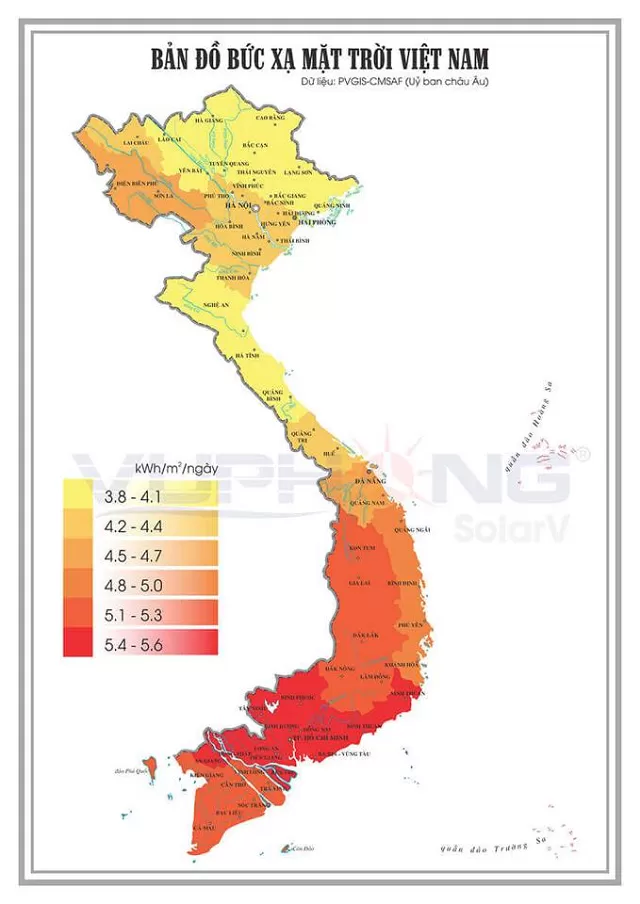
- According to the assessment of experts at the Vietnam Clean Energy Association, our country is a country located in the tropical monsoon region. The place with the highest amount of sunlight on the world solar radiation map. The average annual amount of solar radiation in our country ranges from 4.3 to 5.7 million kWh/m2. In which regions such as the Central Highlands and South Central region, the number of sunshine hours will be from 2000 to 2600 hours per year. The average amount of solar radiation is about 150kcal/m2 accounting for about 2000 to 5000 hours per year.
- Accordingly, it is estimated that the theoretical potential of solar power is about 43.9 billion TOE. According to the outlook and plan given in 2020, it is expected to exploit about 850MW of solar power. By 2025, the total exploited solar power is estimated to increase to 4,000MW. And it is expected to achieve 12,000MW of electricity from solar energy in 2030.
2. Policy mechanisms for solar power development
According to Decision No. 2068/QD-TTg dated November 25, 2015 of the Prime Minister, the goals and orientations for solar energy development are as follows:
- Objective: the strategic goal is to increase electricity output produced from renewable energy from about 58 billion kWh in 2015 to about 101 billion kWh in 2020, about 186 billion kWh in 2030 and about 452 billion kWh in 2050. The proportion of electricity produced from renewable energy in the total electricity produced nationwide increased from about 35% in 2015. 2015 increases to about 38% in 2020, about 43% in 2050.
- Orientation for developing solar energy sources:
Develop solar power to provide electricity for the national electricity system and border areas, islands, remote areas that cannot be supplied with electricity from the national grid. Electricity produced from solar energy increases from about 10 million kWh in 2015 to about 1.4 billion kWh in 2020; about 35.4 billion kWh in 2030 and about 210 billion kWh in 2050. Bringing the proportion of electricity produced from solar energy in total electricity production from negligible to about 6% in 2030 and about 20% in 2050.
In addition, according to Decision No. 428/QD-TTg dated March 18, 2016 of the Prime Minister on approving adjustments to the national electricity development plan for the period 2011 - 2020 with a view to 2030. Regarding the development orientation of power sources, including: Accelerating the development of power sources using solar energy, including centralized sources installed on the ground and distributed sources installed on roof: Bringing the total solar power capacity from the current negligible level to about 850 MW in 2020, about 4,000 MW in 2025 and about 12,000 MW in 2030. Electricity produced from solar power accounts for about 0.5% in 2020, about 1.6% in 2025 and about 3.3% in 2030.
3. Necessity of investment
Based on the National Electricity Development Plan for the period 2011-2020, taking into account the adjustment to 2030 approved in Decision No. 428/QD-TTg dated March 18, 2016 of the Prime Minister, the electricity load forecast to 2030 is as follows:
| Category | Unit | 2018 | 2020 | 2025 | 2030 |
| Electricity production | GWh | 220,390 | 265,406 | 400,327 | 571,752 |
| Pmax | MW | 35,126 | 42,080 | 63,471 | 90,651 |
Note: Pmax is the maximum capacity of the power system. Electricity output = Pmax*24h
With electricity demand growing at about 10%/year, Vietnam needs to add about 3,500-4,000 MW of new power capacity each year. In the context that traditional power generation sources are close to the limit such as hydropower (not much room left for development), thermal power (construction progress of thermal power plants is slow compared to plan, no proactive coal supply...), nuclear power has stopped construction, the development of renewable energy sources is being encouraged by the government.
Vietnam is located in the equatorial belt and is considered to have quite high solar potential compared to other countries in the Asian region. According to domestic survey documents, the average total solar radiation in Vietnam is about 5.7 kWh/m2.2/day in the Central and Southern provinces, and is about 3.3 kWh/m2/day in the Northern provinces. From below the 17th parallel, solar radiation is not only abundant but also very stable throughout the year, decreasing about 20% from the dry season to the rainy season. The number of sunshine hours per year in the North is about 1500-1700 hours while in Central and Southern Vietnam, this number is about 2000-2600 hours per year.
4. Solar panels and Inverter
- The most important elements of solar power projects are photovoltaic panels and power converters.
- Solar panels have the function of converting from solar energy to electricity.
- Inverter is a converter from the power of the panels to the appropriate voltage for connection to the grid.
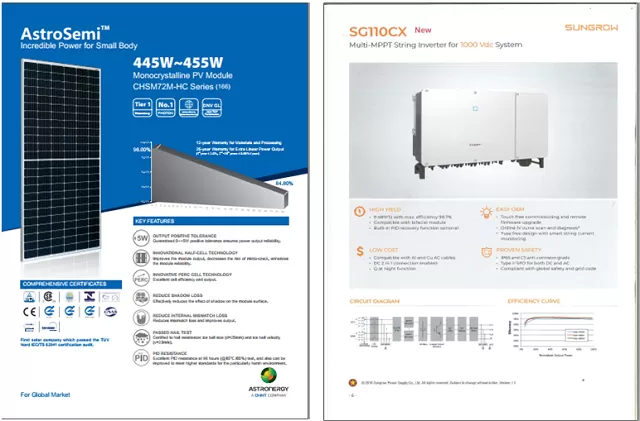
Photovoltaic panels and inverters
5. Principle of solar power plant
- Using an endless source of energy, sunlight, is absorbed by photovoltaic panels and converted to DC power. Because the power source of each of these panels has a small voltage, many panels will be connected in series to create a high DC voltage, then fed into the inverter to convert DC current and voltage into 3-phase AC electricity.
- A solar power farm of 1MWp, including 9 inverters with a capacity of 100KVA-121KVA will be connected to 1 1000KVA MBA to connect to the 22kv EVN grid.
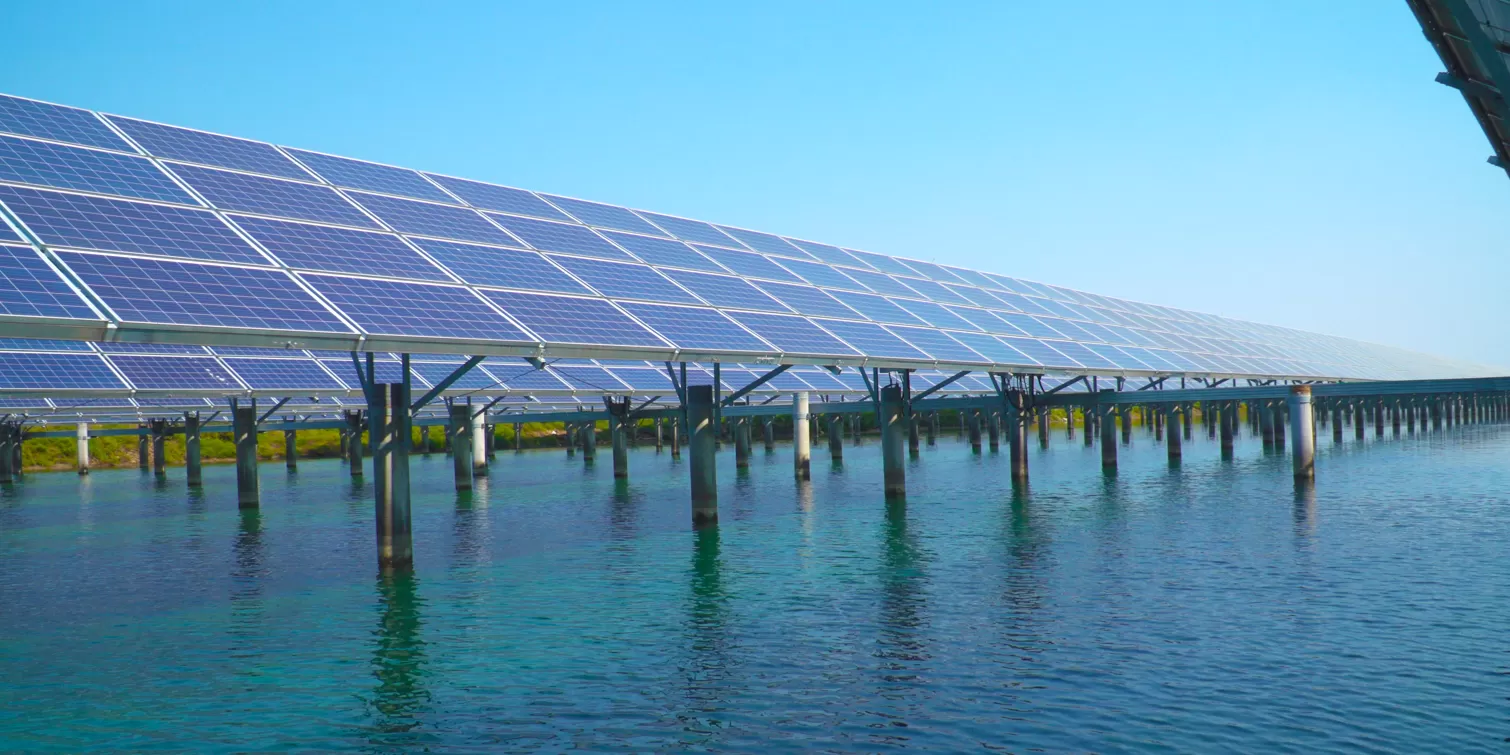
- Solar power is built in places with good radiation sources, and utilized below for agricultural development.
Author: Ngo Ngoc Bich








Comment